Examples
Functional Plots
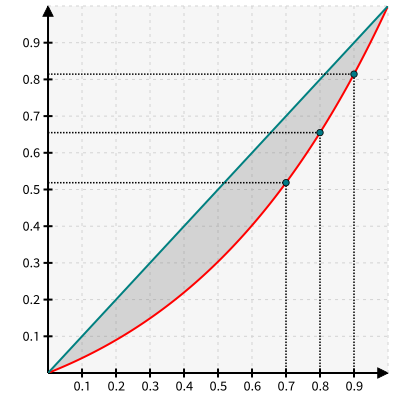
with (zp.GraphQuad()
      .xticks(zp.ticker[0:1:.1])
      .yticks(zp.ticker[0:1:.1])
      .size(400, 400)) as g:
    f1 = zp.Function(lambda x: x*math.exp(x-1), (0,1)).color('red')
    f2 = zp.Line.from_slopeintercept(1, 0).color('teal')
    zp.IntegralFill(f1, f2, 0, 1).color('gray 30%')
    zp.Point.at(f1, .8).guidex().guidey()
    zp.Point.at(f1, .9).guidex().guidey()
    zp.Point.at(f1, .7).guidex().guidey()
with (zp.GraphQuad()
        .css(zp.CSS_BLACKWHITE+zp.CSS_NOGRID)
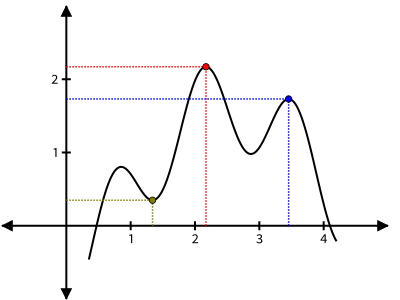
        .xrange(-1, 5).yrange(-1, 3)) as g:
    f = zp.Function(
        lambda x: 0.6*math.cos(4.5*(x-4)+2.1) - 1.2*math.sin(x-4)+.1*x+.2,
        (.35, 4.2)).color('black')
    zp.Point.at_minimum(f, 1, 2).color('olive').guidex().guidey()
    zp.Point.at_maximum(f, 2, 2.5).color('red').guidex().guidey()
    zp.Point.at_maximum(f, 3, 4).color('blue').guidex().guidey()
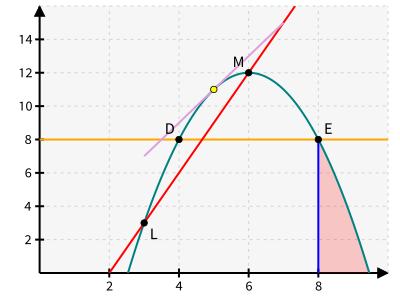
with (zp.GraphQuad()
      .xrange(0, 10)
      .yrange(0, 16)):
    f = zp.Function(lambda x: -(x-6)**2 + 12).color('teal')
    f.secant(4, 8).color('orange')
    f.secant(3, 6).color('red')
    m = zp.Point.at(f, 6).label('M', 'NW').color('black')
    d = zp.Point.at(f, 4).label('D', 'NW').color('black')
    e = zp.Point.at(f, 8).label('E', 'NE').color('black')
    l = zp.Point.at(f, 3).label('L', 'SE').color('black')
    zp.Segment((8, f.y(8)), (8, 0)).color('blue')
    zp.IntegralFill(f, x1=8, x2=9.5).color('red 20%')
    f.tangent(x=5).trim(3, 7).color('plum')
    zp.Point.at(f, 5).color('yellow')
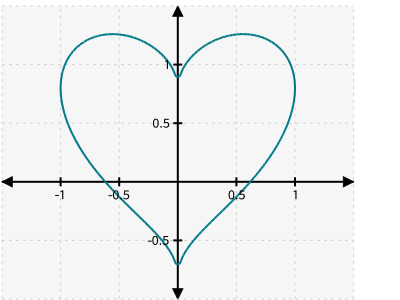
with zp.GraphQuad().equal_aspect():
    zp.Implicit(
        lambda x, y: x**2 + (5*y/4 - math.sqrt(abs(x)))**2 -1,
        xlim=(-1.5, 1.5),
        ylim=(-1.0, 1.5))
Discrete Data
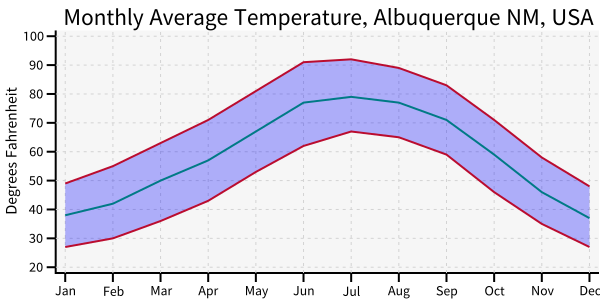
highs = [49, 55, 63, 71, 81, 91, 92, 89, 83, 71, 58, 48]
lows = [27, 30, 36, 43, 53, 62, 67, 65, 59, 46, 35, 27]
means = [38, 42, 50, 57, 67, 77, 79, 77, 71, 59, 46, 37]
months = ['Jan', 'Feb', 'Mar', 'Apr', 'May', 'Jun', 'Jul', 'Aug', 'Sep', 'Oct', 'Nov', 'Dec']

with (zp.Graph()
        .title('Monthly Average Temperature, Albuquerque NM, USA')
        .axesnames(y='Degrees Fahrenheit').xticks(range(12), months)
        .size(600,300)):
    zp.LineFill(range(12), highs, lows)
    zp.PolyLine(range(12), means).color('C2')
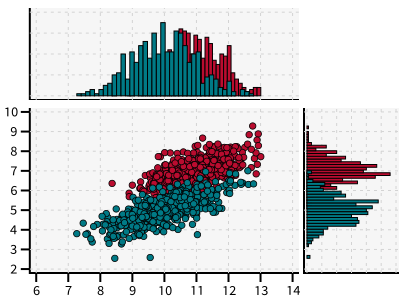
x = [random.normalvariate(10, 1) for _ in range(500)]
y = [xx/2 + random.normalvariate(0, .5) for xx in x]
x2 = [random.normalvariate(11, .75) for _ in range(500)]
y2 = [xx/2 + random.normalvariate(1.5, .5) for xx in x2]

with zp.LayoutGrid(columns=2, column_gap=0, row_gap=0,
                row_heights='1fr 2fr', column_widths='3fr 1fr'):
    with zp.Graph().xrange(6, 14).noxticks().noyticks() as graph1:
        zp.Histogram(x2, bins=40).color('#ba0c2f88')
        zp.Histogram(x, bins=40).color('#007a8688')

    zp.LayoutEmpty()

    with zp.Graph().match_x(graph1) as scatter:
        zp.Scatter(x2, y2).marker('o', 4).color('#ba0c2f88')
        zp.Scatter(x, y).marker('o', 4).color('#007a8688')

    with zp.Graph().match_y(scatter).noyticks().noxticks():
        zp.HistogramHoriz(y2, bins=30).color('#ba0c2f88')
        zp.HistogramHoriz(y, bins=30).color('#007a8688')
Geometric
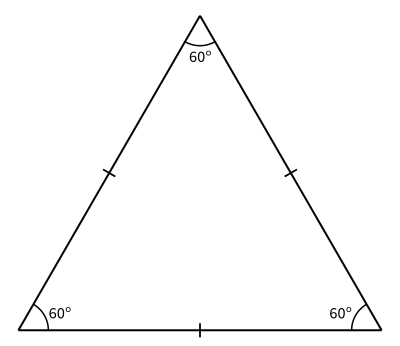
CSS = '''
    Angle {
        radius: 30;
        font_size: 14;
    }
'''
with (zp.Diagram()
      .css(zp.CSS_BLACKWHITE + CSS)
      .xrange(0, 1).yrange(0, math.sqrt(3)/2)
      .size(400, 400*math.sqrt(3)/2)) as g:
    a = zp.Segment((0, 0), (1, 0))
    b = zp.Segment((1, 0), (.5, math.sqrt(3)/2))
    c = zp.Segment((.5, math.sqrt(3)/2), (0, 0))
    a.midmarker('|')
    b.midmarker('|')
    c.midmarker('|')
    zp.Angle(a, b, quad=2).label('60°')
    zp.Angle(b, c, quad=3).label('60°')
    zp.Angle(a, c, quad=4).label('60°')
with zp.Diagram().css(zp.CSS_BLACKWHITE).xrange(0, 1).yrange(0, .6).size(300,200):
    c = zp.Segment((0, 0), (1, 0)).label('c', .5, 'S', color='blue')
    a = zp.Segment((1, 0), (.7, .6)).label('a', .5, 'E', color='blue')
    b = zp.Segment((.7, .6), (0, 0)).label('b', .5, 'NW', color='blue')
    zp.Angle(b, c, quad=4).color('red').label(r'$\alpha$', color='red')
    zp.Angle(a, c, quad=2).color('red').label(r'$\beta$', color='red')
    zp.Angle(a, b, quad=3).color('red').label(r'$\gamma$', color='red')
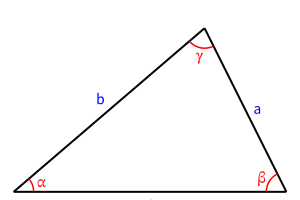
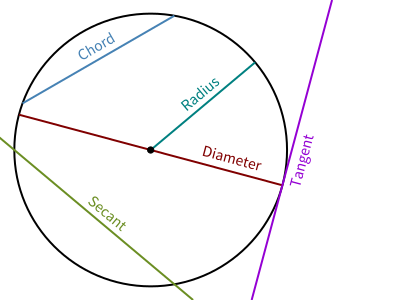
with zp.Diagram().css(zp.CSS_BLACKWHITE).xrange(-1, 1.1).yrange(-1., 1):
    c = zp.Circle((0, 0), 1)
    c.diameter_segment(angle=-15).color('maroon').label('Diameter', .2, 'N', rotate=True, color='maroon')
    c.radius_segment(angle=40).color('teal').label('Radius', .5, rotate=True, color='teal')
    c.chord(160, 80).color('steelblue').label('Chord', .5, rotate=True, color='steelblue')
    c.secant(180, 280).color('olivedrab').label('Secant', .25, rotate=True, color='olivedrab')
    c.tangent(c.xy(-15)).color('darkviolet').label('Tangent', .4, 'SE', rotate=True, color='darkviolet')
    zp.Point((0, 0))
with (zp.GraphQuad()
        .css(zp.CSS_BLACKWHITE+zp.CSS_NOGRID)
        .size(500, 500)
        .xrange(-2, 2).xticks(zp.ticker[-2:2:1], minor=zp.ticker[-2:2:.1])
        .yrange(-2, 2).yticks(zp.ticker[-2:2:1], minor=zp.ticker[-2:2:.1])) as d:
    theta = 40
    circ = zp.Circle((0, 0), 1)
    xaxis = zp.HLine(0)
    x1 = zp.VLine(1).stroke('--').label('x=1', .25, 'E')
    y1 = zp.HLine(1).stroke('--').label('y=1', .25, 'N')
    hyp = zp.Line((0,0), math.tan(math.radians(theta)))
    tan = circ.tangent_at(theta)

    zp.Point((0, 0)).label('O', 'SE').color('red')
    A = zp.Point.at_intersection(hyp, tan).label('A', 'E').color('red')
    B = zp.Point.at_intersection(x1, hyp).label('B', 'W').color('red')
    C = zp.Point.at_intersection(y1, hyp).label('C', 'N').color('red')
    D = zp.Point.at(tan, x=0).label('D', 'E').color('red')
    E = zp.Point.at_y(tan, y=0).label('E', 'SW').color('red')

    cot = zp.Segment.horizontal(C.point).strokewidth(4).color('green').label('cot θ', .4, 'N', color='green')
    sin = zp.Segment.vertical(A.point).strokewidth(4).color('cyan').label('sin θ', .6, 'W', color='cyan')
    sec = zp.Segment((0, 0), E.point).strokewidth(4).color('purple').label('sec θ', .5, 'S', color='purple')
    csc = zp.Segment((0, 0), D.point).strokewidth(4).color('orange').label('csc θ', .5, 'W', color='orange')
    tan = zp.Segment.vertical(B.point).strokewidth(4).color('blue').label('tan θ', .6, 'E', color='blue')
    cos = zp.Segment.horizontal(A.point).strokewidth(4).color('lime').label('cos θ', .6, 'N', color='lime')
    zp.Angle.to_zero(hyp, quad=4).label('θ')
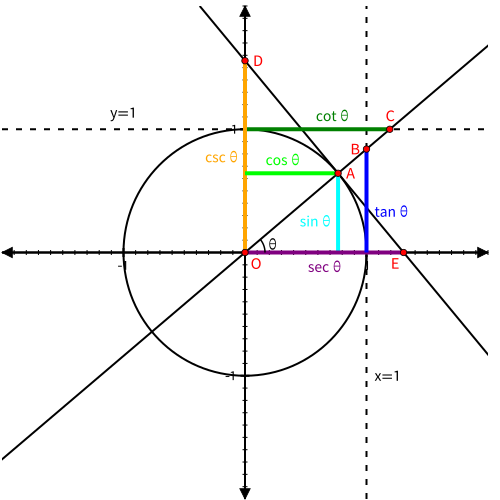
(Based on Unit Circle from Wikipedia)

with zp.Diagram().css(zp.CSS_BLACKWHITE):
    circle = zp.Circle((0, 0), 1)
    theta = 56  # Angle for point B
    circle.diameter_segment()
    side1 = circle.chord(180, theta)
    side2 = circle.chord(0, theta)
    a = zp.Point.on_circle(circle, 180).label('A', 'W')
    c = zp.Point.on_circle(circle, 0).label('C', 'E')
    b = zp.Point.on_circle(circle, theta).label('B', 'NE')
    zp.Point((0, 0)).label('O', 'S')
    zp.Angle(side1, side2, quad=3)

# Test Thales's Theorem!
math.isclose(zp.geometry.intersect.line_angle(side1, side2), math.radians(90))
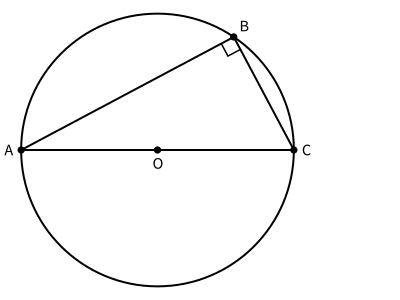
True
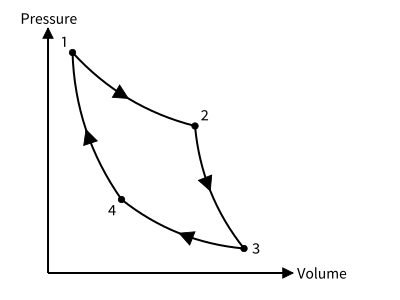
with (zp.GraphQuad()
        .axesnames('Volume', 'Pressure')
        .css(zp.CSS_BLACKWHITE)
        .xrange(0, 1).yrange(0, 1)
        .noxticks().noyticks()
        .equal_aspect()):
    p1 = zp.Point((.1, .9)).label('1', 'NW')
    p2 = zp.Point((.6, .6)).label('2', 'NE')
    p3 = zp.Point((.8, .1)).label('3', 'E')
    p4 = zp.Point((.3, .3)).label('4', 'SW')
    zp.Curve(p2.point, p1.point).midmarker('>')
    zp.Curve(p3.point, p2.point).midmarker('>')
    zp.Curve(p3.point, p4.point).midmarker('<')
    zp.Curve(p4.point, p1.point).midmarker('<')
css = zp.CSS_BLACKWHITE + '''
    * {
        font_size: 22;
    }
    Circle {
        stroke_width: 3;
    }
    Segment {
        stroke_width: 5;
    }
    Angle {
        stroke_width: 3;
    }
    Radius {
        stroke_width: 4;
        }
    '''
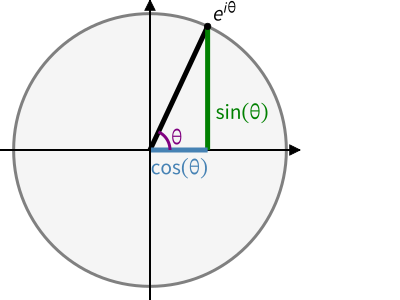
with zp.Diagram().css(css):
    circ = zp.Circle((0, 0), 1).color('gray').fill('whitesmoke')
    zp.Arrow((1.1, 0), (-1.1, 0)).zorder(2)
    zp.Arrow((0, 1.1), (0, -1.1))
    rad = circ.radius_segment(65)
    pt = zp.Point.on_circle(circ, theta=65).label(r'$e^{iθ}$')
    sin = zp.Segment.vertical(pt.point, 0).color('green').label(r'sin(θ)', .7, 'E')
    cos = zp.Segment.horizontal(sin.p2, 0).color('steelblue').label(r'cos(θ)', .5, 'S')
    zp.Angle(rad, cos, quad=4).color('purple').label('θ')
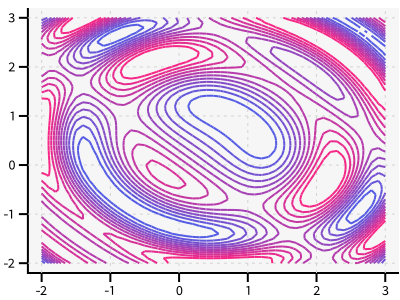
Contour Plots
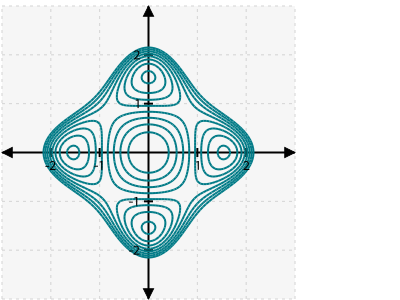
with zp.GraphQuad().equal_aspect():
    for c in zp.linspace(-3, 3, 8):
        zp.Implicit(lambda x, y: .25*(5*x**2 + y**2 -4)*(x**2+5*y**2 - 4) - c,
                    xlim=(-3, 3), ylim=(-3, 3))
CSS = '''
    Contour {
        colorfade: #4361EE, #F72585;
    }
'''
delta = .1
x = zp.util.zrange(-2, 3, delta)
y = zp.util.zrange(-2, 3, delta)
z = [[2 * (math.sin(-xx**2 - yy**2) - math.cos(-(xx-1)**2 - (yy-1)**2)) for xx in x] for yy in y]
with zp.Graph().css(CSS).size(400,300):
    p = zp.Contour(x, y, z, levels=12)